
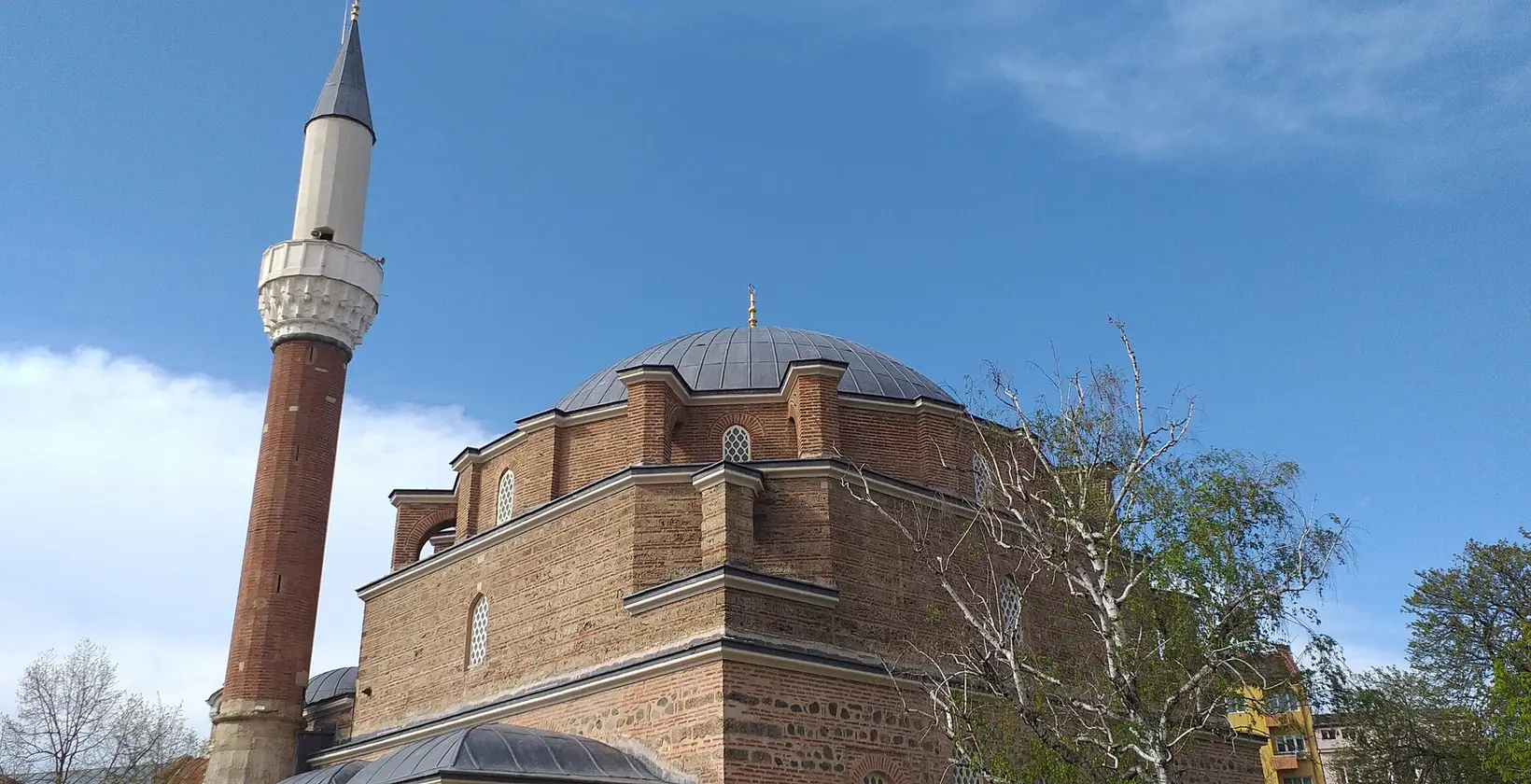
The prayer hall
The prayer hall is square. Its walls are 15 metres high and 1.8 metres thick, and they are built of stone and brick laid in alternating courses, a technique you will see in many Ottoman buildings.1
At the top of the walls the square becomes an octagon. On the outside the corners are simply cut off, while on the inside small arches called squinches span them. Above the octagon rises a round brick drum, divided into sixteen sections and braced by buttress arches, and on top of the drum sits the main dome, 15 metres in diameter. The domes and vaults are roofed with lead.1
Light comes in through four rows of windows. The lowest ones are rectangular, and the ones higher up are arched or round.1
The portico and the entrance
In front of the door is an open portico, which in Turkish is called son cemaat yeri, the place for latecomers. It rests on four columns with stalactite (muqarnas) capitals, linked by pointed arches, and is roofed with three small domes.1
The doorway is framed in cut stone and topped with a pediment. On each side of it there is a niche with a stalactite hood.1
On the right-hand side of the mosque there is an annex under three vaults, known as the tetimme. Kadı Seyfullah Efendi built it in memory of his late wife, and it was probably used for teaching children.1
The minaret
The minaret stands to the right of the mosque and has a single balcony (şerefe). Evliya Çelebi thought there was no lovelier minaret in Sofia.1 Its brick shaft rises from a square base of cut stone. The stone balcony rests on a band of stalactite carving, and the minaret ends in a wooden cone covered with lead. During the repairs of 1915–17 it was reshaped and made shorter.1
Inside
In 2007 the mihrab and the walls up to the second row of windows were covered with Kütahya tiles. A new tiled minbar and kürsü were put in, and the painted decoration (kalem işi) on the squinches, pendentives, window surrounds and dome was renewed.1 You can see the hall for yourself on the 360° tour.
The parts of a mosque
The mihrab is the niche in the front wall. It shows the direction of prayer (qibla), which is towards the Kaaba in Mecca, and the imam stands in front of it when he leads the prayer.23
The minbar is a raised pulpit reached by a flight of steps. At the Friday and festival prayers the preacher (khatib) gives the sermon (khutba) from it.4
The kürsü is a raised seat, usually with a few steps up to it, used for talks and lessons.5
The mahfil is a separate area, usually raised, set aside for the muezzins, for women or for guests.6 You can see the mahfil of Banya Bashi on the 360° tour.
The minaret is the tower from which the call to prayer (adhan) is made. The word comes from the Arabic manāra, “a place where light is seen”.7
The dome is the hemispherical roof over the prayer hall.8
The şadırvan is a fountain next to the mosque where people perform the ritual washing (wudu) before prayer.9
Footnotes
-
Sefer Hasanov, “Kadı Seyfullah Efendi Camii”, TDV İslâm Ansiklopedisi, suppl. vol. 1, pp. 699–701. https://islamansiklopedisi.org.tr/kadi-seyfullah-efendi-camii ↩ ↩2 ↩3 ↩4 ↩5 ↩6 ↩7 ↩8 ↩9
-
Tuğba Erzincan, “Mihrap”, TDV İslâm Ansiklopedisi, vol. 30, pp. 30–37. https://islamansiklopedisi.org.tr/mihrap ↩
-
“Kıble”, TDV İslâm Ansiklopedisi, vol. 25, pp. 364–369. https://islamansiklopedisi.org.tr/kible ↩
-
Nebi Bozkurt, Zeynep Hatice Kurtbil, “Minber”, TDV İslâm Ansiklopedisi, vol. 30, pp. 101–106. https://islamansiklopedisi.org.tr/minber ↩
-
Yaşar Çoruhlu, “Kürsü”, TDV İslâm Ansiklopedisi, vol. 26, pp. 573–574. https://islamansiklopedisi.org.tr/kursu ↩
-
M. Baha Tanman, “Mahfil”, TDV İslâm Ansiklopedisi, vol. 27, pp. 331–333. https://islamansiklopedisi.org.tr/mahfil ↩
-
Filiz Gündüz, “Minare”, TDV İslâm Ansiklopedisi, vol. 30, pp. 98–101. https://islamansiklopedisi.org.tr/minare ↩
-
Selçuk Mülâyim, “Kubbe”, TDV İslâm Ansiklopedisi, vol. 26, pp. 300–303. https://islamansiklopedisi.org.tr/kubbe ↩
-
Ali Kılcı, “Şadırvan”, TDV İslâm Ansiklopedisi, vol. 38, pp. 219–221. https://islamansiklopedisi.org.tr/sadirvan ↩